
PAN (Partner Acquisition & Nurturing) For Service Businesses is a GAME CHANGER
Why I Wrote This
Over the years, I’ve watched highly capable service professionals work harder and harder at growth, investing more time in networking, more money in marketing, and more energy into relationship-building … yet feel increasingly frustrated by inconsistent results.
The common thread isn’t a lack of effort or skill. It’s that the rules of growth have changed. Professional networks are larger. Attention is fragmented. Trust is harder to earn. And without structure, even strong relationships begin to dilute over time.
PAN (Partner Acquisition & Nurturing) is the system I’ve seen work best in this environment. Not as a tactic, but as a practical operating model for turning relationships into predictable growth.
PAN is a system I’ve been developing and evolving over the last few years through practical, real-world application with service-based businesses.
Introduction
Most service‑based businesses face a hard reality: traditional growth models were not built for firms with limited marketing budgets, long sales cycles, and small teams.
While digital marketing and Account‑Based Marketing (ABM) can work well for large organizations, they often become prohibitively expensive and operationally heavy for smaller firms.
The result is a familiar pattern:
Rising advertising costs
Significant time spent qualifying leads
Deep skepticism from prospects who don’t yet trust you
Limited access to senior decision‑makers inside target accounts
The real constraint isn’t demand … it’s trusted access.
1. Why Traditional Go‑to‑Market
Approaches Break Down
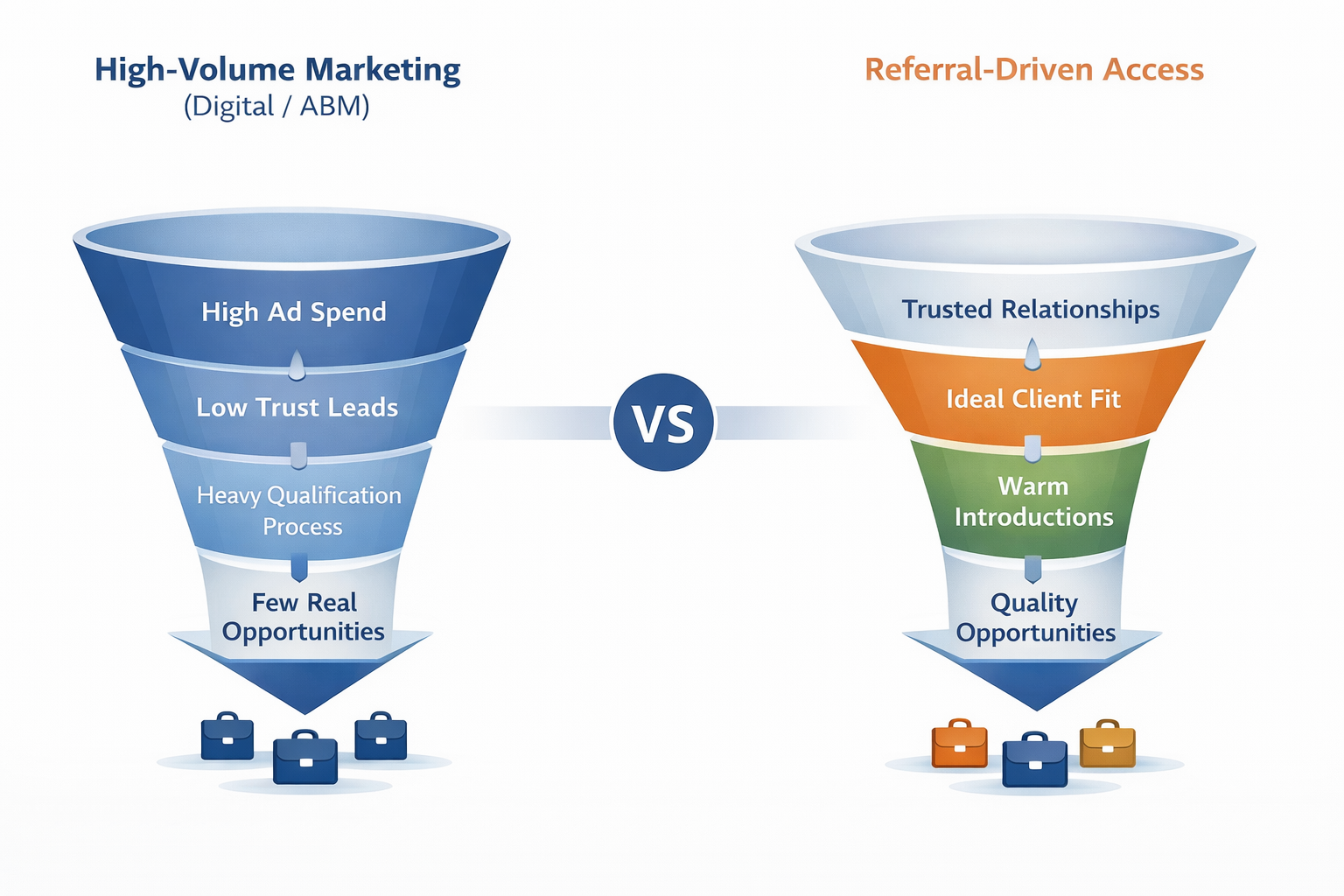
Digital marketing and ABM strategies tend to prioritize volume.
For smaller service businesses, this often creates more noise than real opportunity. Teams invest heavily to generate leads, then spend even more time separating true opportunity from casual interest.
Worse, many of these leads arrive with built‑in skepticism. Without prior trust or context, prospects remain guarded … especially at the senior decision‑maker level.
High effort does not equal a high probability of engaging a new customer.
As traditional marketing becomes more expensive and less effective, many service businesses naturally turn to relationships as an alternative growth path. But without structure, this shift introduces a different, and often hidden, set of costs.
2. The Hidden Cost of Unstructured
Relationships
In response to the limitations of traditional marketing, most service businesses lean more heavily on relationships for growth … but often in an informal, ad hoc way.
Follow‑ups live in inboxes. Priorities live in people’s heads. Effort is spread unevenly across too many connections.
The result is predictable:
too many coffees and lunches
too little clarity on the ROI of the time you’re investing
missed opportunities that exist but aren’t visible
inconsistent and sporadic referral business
Good intentions alone do not translate into new customers or increased revenues
3. Why Referral Partners Change the
Equation
This is where referral partners fundamentally change the equation. Not by adding another tactic, but by eliminating both sources of inefficiency at once: the high cost of volume-driven marketing and the hidden dilution of unmanaged relationships.
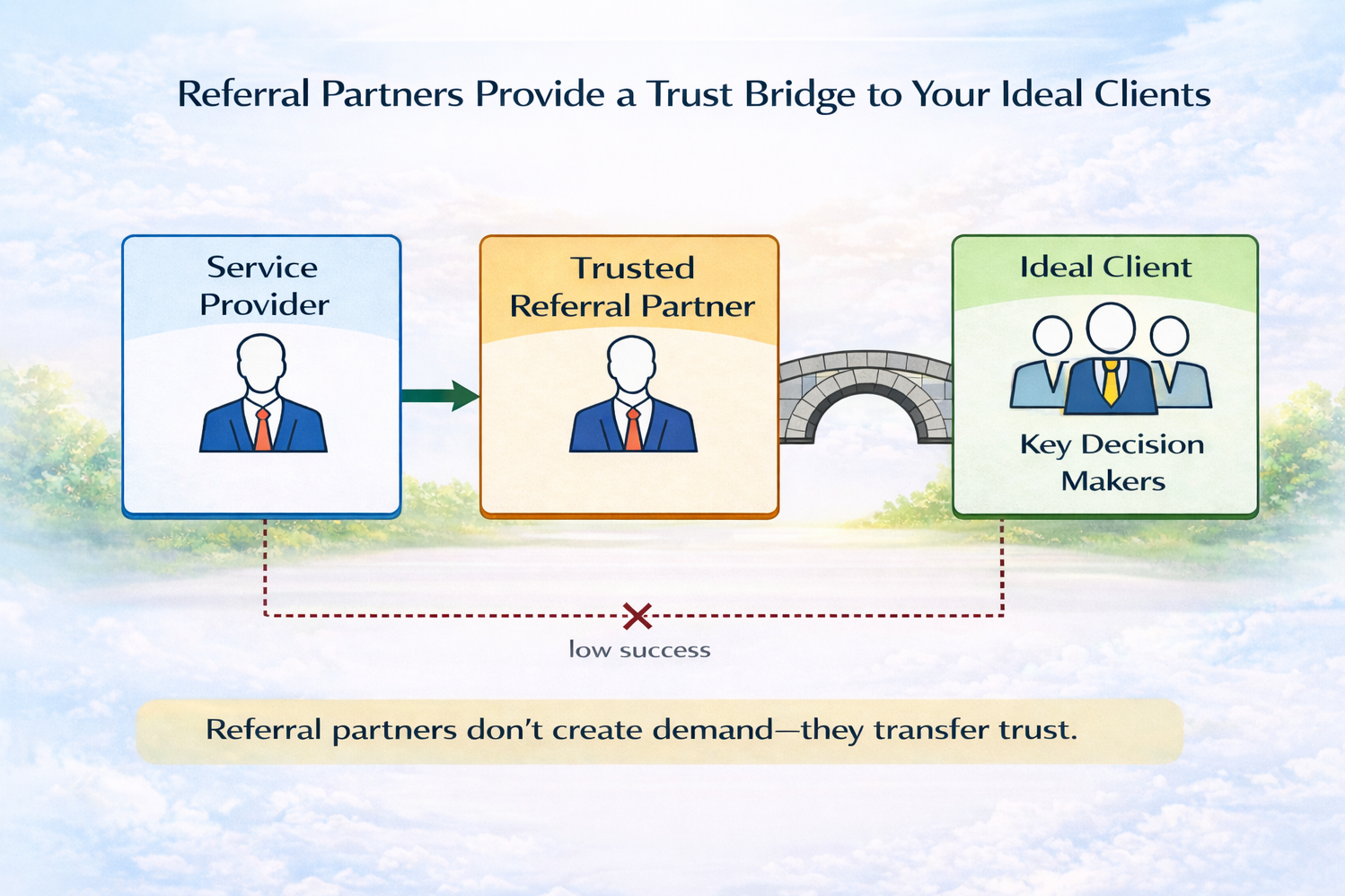
Referral partners operate inside the inner circle of trust. They already have credibility, context, and access within organizations that fit your Ideal Client Profile (ICP).
When a trusted partner makes an introduction:
defenses are lowered
relevance is immediately established
sales cycles shorten
conversion rates improve
Referral partners create a “trust bridge” in a way that lowers initial buyer skepticism, paving the way to shorter sales cycles.
4. The Solution Is PAN
(Partner Acquisition & Nurturing)
PAN is a system for turning relationship‑driven growth into something intentional, measurable, and repeatable.
Rather than chasing volume, PAN focuses on identifying the right partners, prioritizing relationships that matter, and nurturing with intent. PAN also emphasizes measuring engagement and outcomes.
PAN is not networking. It is relationship management with discipline.
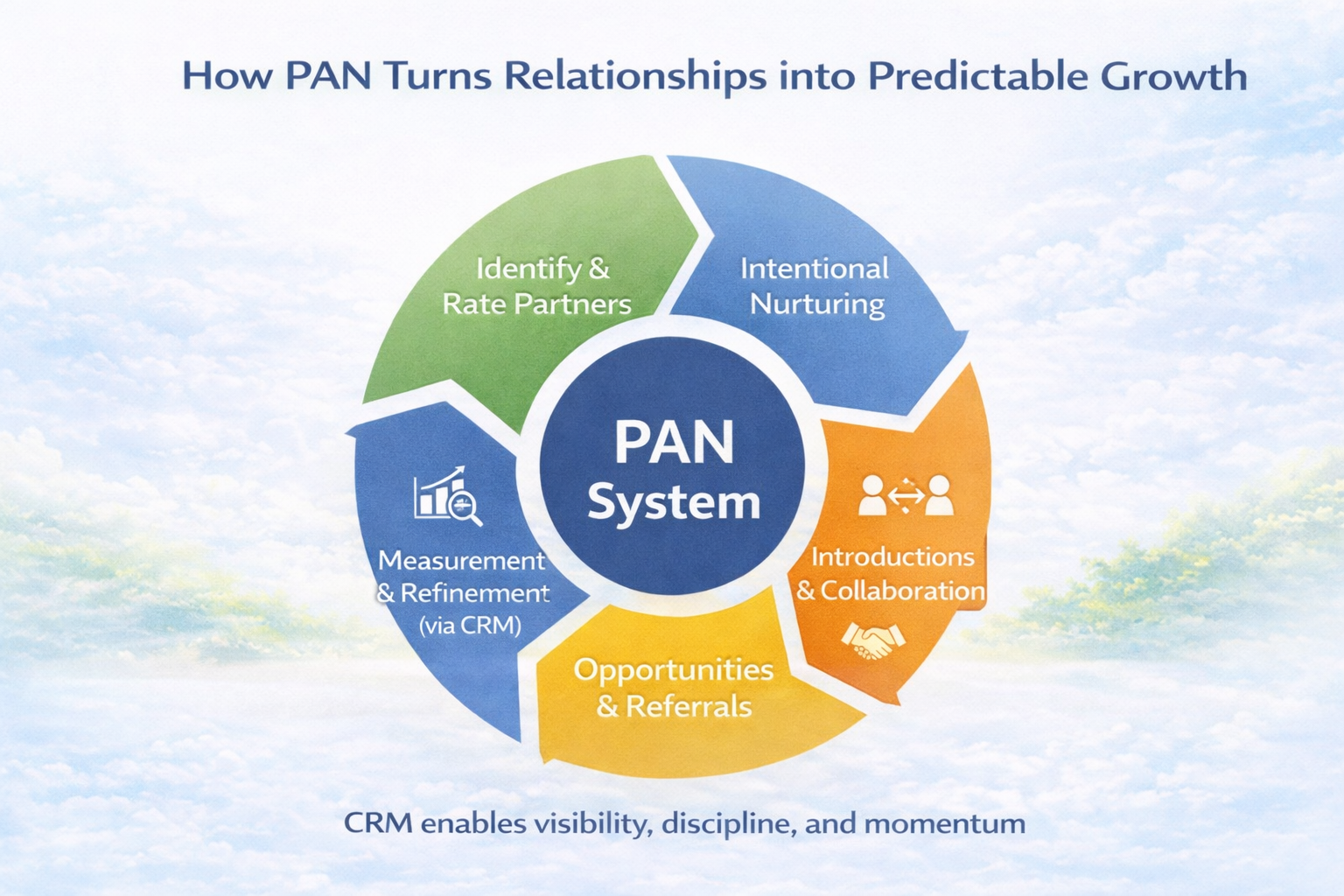
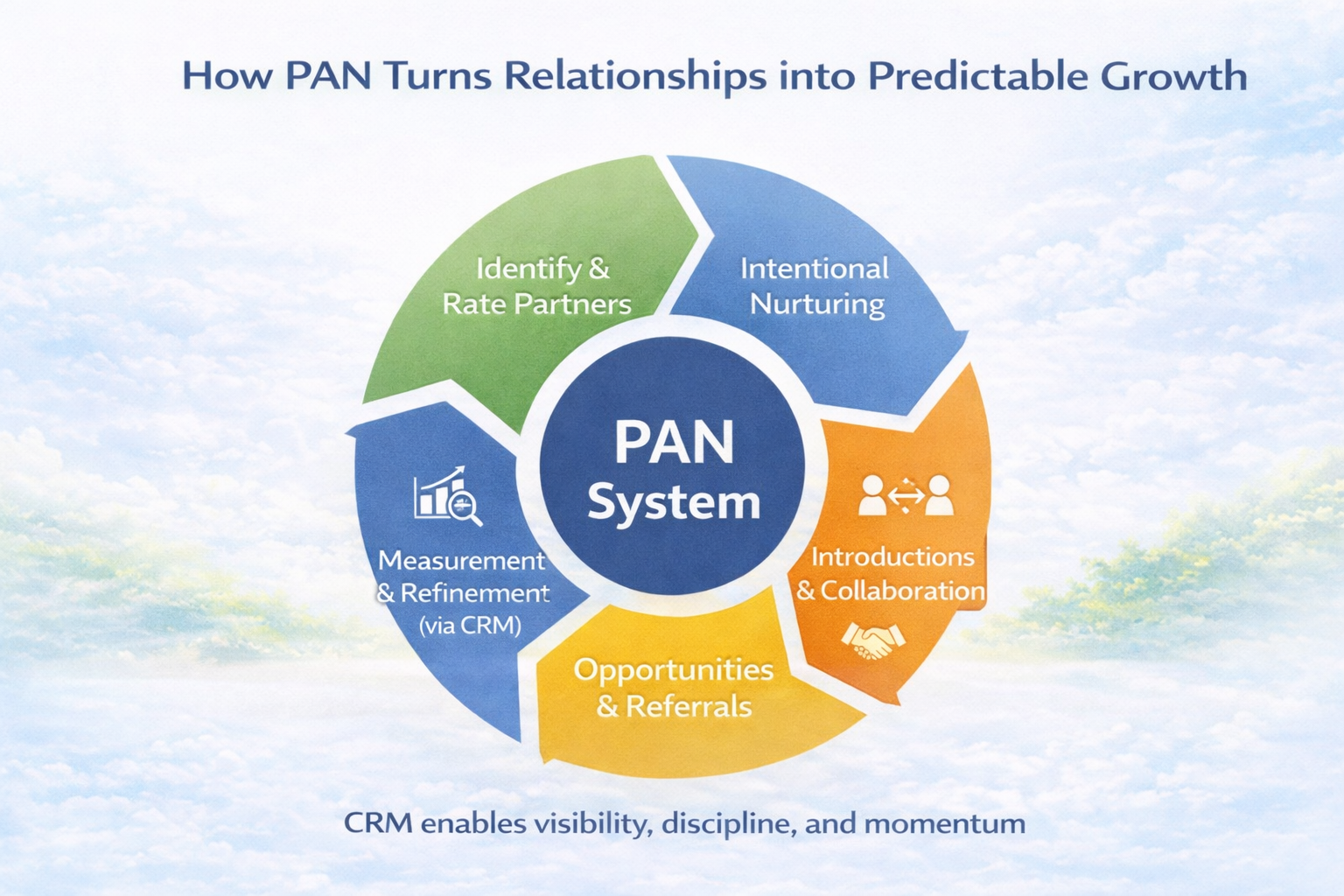
PAN works as a continuous system, not a one‑time initiative. Each cycle strengthens the next.
Partners are identified and rated. Relationships are nurtured intentionally. Introductions and collaboration surface real opportunities. Outcomes are measured, and focus is refined.
Over time, momentum builds. Take a careful look at the graphic below … the system is intuitive!
5. The Role of CRM in PAN
Whether we like it or not, most professionals today are required to build and manage larger, more diverse networks than ever before. As networks grow, the risk isn’t lack of effort … it’s dilution. Without structure, attention spreads thin, follow‑up becomes inconsistent, and even strong relationships begin to weaken.
A CRM is no longer optional infrastructure for this reality. It is the only practical way to manage a growing network without losing focus or effectiveness.
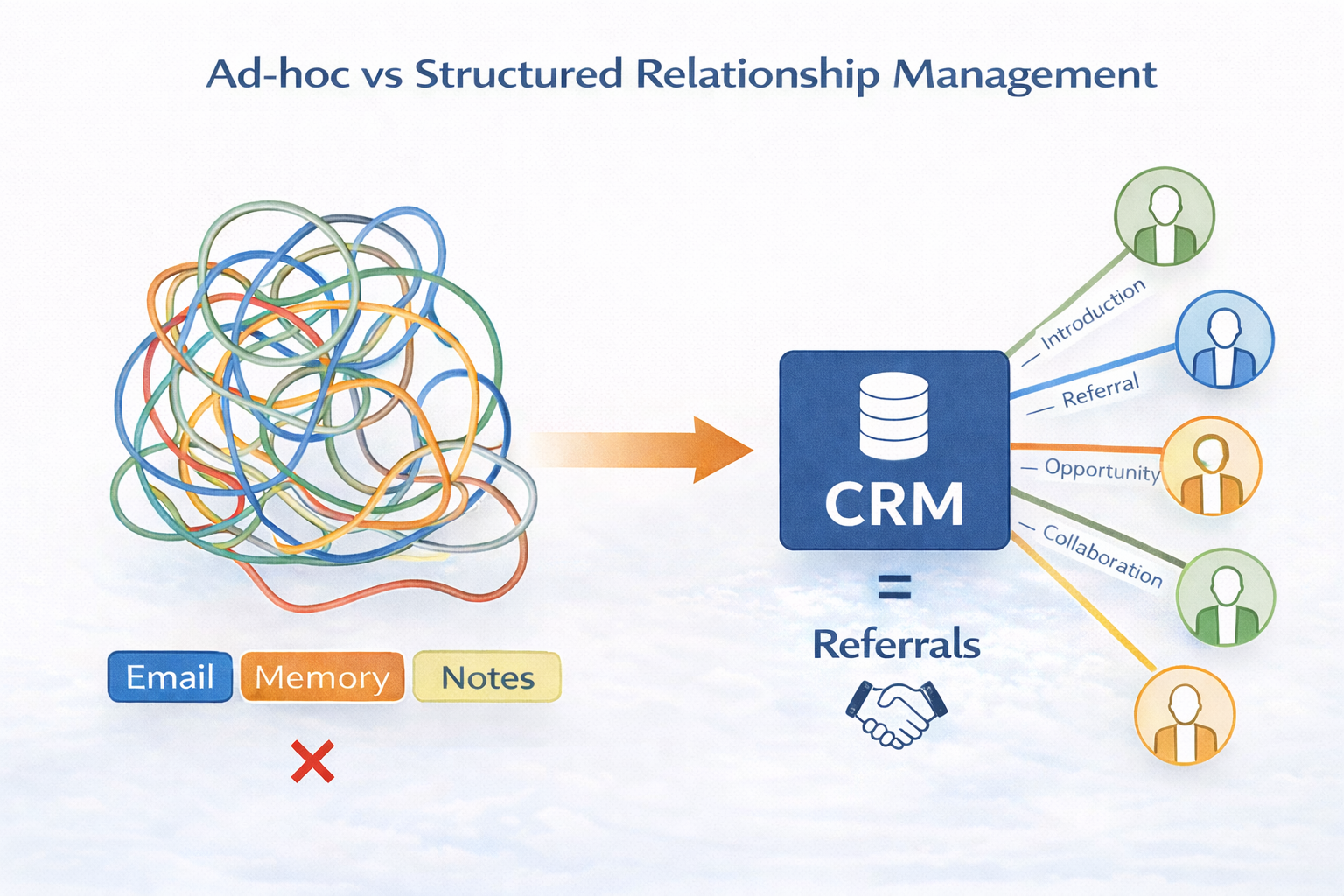
In the context of PAN, the CRM plays two critical roles:
1. Preventing Network Dilution
CRMs allow you to centralize relationships, segment partners intelligently, and maintain intentional cadence. Without this structure, networking activity tends to devolve into reactive meetings and forgotten follow‑ups … high effort with diminishing returns.
2. Making Partner Interest and Engagement Visible
Not all partners demonstrate the same level of interest, responsiveness, or intent at the same time. The most effective PAN-oriented CRMs surface signals such as:
responsiveness to outreach
engagement with shared content
participation in introductions or collaboration
Just as important, engagement signals must be made visible and usable through partner-centric reporting and dashboards. Traditional CRM dashboards are typically buyer-focused … optimized for leads, deals, and pipeline. PAN requires a different lens.
Partner-centric dashboards are designed to:
highlight engagement trends across your partner network
quickly identify which partners are leaning in
distinguish highly rated partners from passive or inactive ones
guide where time, energy, and collaboration efforts should be focused
This approach allows you to identify your strongest partners based on observed behavior, not memory or assumption … enabling you to adjust your focus as engagement levels change.
These capabilities should be a primary determinant when selecting a CRM. The goal is not simply growing your contact list, but clarity … understanding who is engaged, who is neutral, and where opportunity is emerging.
6. Conclusion: There’s a Better Way
to Grow
Service businesses don’t need louder marketing. They need better access to decision-makers, stronger relationships with their network partners and a more purposeful way of generating referrals to support their growth.
PAN provides this needed structure. Relationships provide the trust. Together, they create sustainable growth.
Let’s Talk
If this way of thinking resonates and you’d like to compare notes, feel free to email me at robin@rwhitelawconsulting.com.
CLICK HERE to complete a form providing some context in advance for a more thoughtful conversation about how PAN might apply to your situation … with or without my help.
Subscribe
If you enjoyed the content of this blog CLICK HERE to subscribe

Robin Whitelaw
Founder, RWCI
Helping small B2B service businesses grow through Purposeful Referral Growth.
📧 robin@rwhitelawconsulting.com |
🌐 rwhitelawconsulting.com |
🔗 linkedin.com/in/robinwhitelaw